7 Best Ratchet and Socket Sets (October 2026)
The best ratchet and socket sets include the DeWalt 34-piece 1/4 and 3/8 inch socket set for mixed home repairs, the WORKPRO 39-piece 1/4 and 3/8 inch socket set for small fastener jobs, and the EPAuto 40-piece socket set with 72-tooth ratchet for occasional repair jobs.
On this page (8 sections)
- Which best ratchet and socket set fits your work?
- How do you choose the best ratchet and socket set?
- Which accessories solve real access problems?
- How should you set up a socket set for the first job?
- Which mistakes damage sockets and fasteners?
- When is a larger set worth the space?
- How should you care for a ratchet and socket set?
- Which ratchet and socket set should you buy?
The best ratchet and socket set for general use is the DeWalt 34-piece set, especially if you want tools that move easily between a carry case and a tool chest. Choose WORKPRO for smaller fasteners and extra turning tools, or Tekton for wider socket coverage.
Start with the repairs you expect to make, then match socket sizes, depth and drive size to those jobs. A higher piece count won't help if the socket you need is missing.
For complete garage kits, see our mechanics tool sets buying guide. Our best socket sets roundup covers more options if sockets matter more to you than extra hand tools.
Our picks at a glance
-
1
 Best for mixed home repairs
DeWalt 34-piece 1/4 and 3/8 inch socket set
8.6/10 our score
See it on Amazon -
2
 Best for small fastener jobs
WORKPRO 39-piece 1/4 and 3/8 inch socket set
8.4/10 our score
See it on Amazon -
3
 Best for occasional repair jobs
EPAuto 40-piece socket set with 72-tooth ratchet
8.3/10 our score
See it on Amazon
- 4
 Check it
Egofine 34-piece 3/8 inch socket set
Best for routine vehicle upkeep - 5
 Check it
Milwaukee 1/4 inch ratchet and socket set
Best for cramped fastening jobs - 6
 Check it
Cartman 205-piece ratchet and socket set
Best for first household kits - 7
 Check it
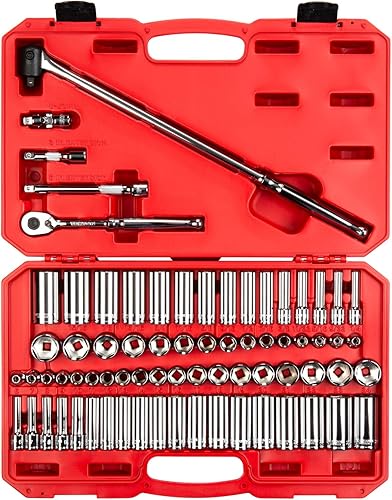
Tekton 73-piece 3/8 inch socket and ratchet set
Best for regular garage repairs
Which best ratchet and socket set fits your work?
Choose DeWalt for mixed routine repairs, WORKPRO for smaller hardware, and Tekton for jobs needing a broad shallow and deep assortment. The other picks suit more specific needs, including cramped workspaces and building a first household tool kit.
We compared socket coverage, drive tools, access features and storage, with general repair needs as the starting point. A lower-ranked set can still be the better buy when its contents match your work more closely.
DeWalt 34-piece 1/4 and 3/8 inch socket set
- 1/4 and 3/8 in drives
- SAE and metric sockets
- 72-tooth ratchet with 5-degree arc swing
- Locking, stackable case
A practical starting point for routine fastening jobs across the home and garage. The removable tray suits buyers who move tools between a carry case and a tool chest.
Pros
- Two drive sizes
- Hard-stamped socket markings and knurled rings
- Removable tray and locking case
Cons
- Limited assortment compared with a full mechanics kit
- Buyers needing deep sockets should verify coverage
DeWalt is the practical starting choice for buyers splitting their time between household hardware and routine garage jobs. Its 1/4 and 3/8 in drives and SAE and metric sockets give you options without moving straight to a large mechanics kit.
The ratchet has 72 teeth and a 5-degree arc swing. That short reset movement helps when nearby parts limit the space available for your hand, though you still need room to fit the head and socket.
Hard-stamped markings identify the sockets, while knurled rings provide a grip point when handling them. Those details are useful when you're changing sizes with dusty or slightly oily fingers.
The removable inner tray is its main storage advantage. It is designed to fit most standard-height tool chest drawers, and the locking outer case can stack and interlock with similar DeWalt mechanics sets.
DeWalt backs this set with a full lifetime warranty. Choose it if organized storage and mixed everyday work matter more than collecting a long run of socket sizes.
Skip it as your only purchase for a repair that needs several deep sockets or unusually large hardware. Check those needs first, since a compact assortment is most useful when its contents fit the job.
WORKPRO 39-piece 1/4 and 3/8 inch socket set
- 1/4 and 3/8 in drives
- SAE and metric sockets
- Spinner handle, extension and adapter
- Blow-molded case
A small-socket-focused kit with several ways to turn and reach fasteners. Choose it for lighter fastening tasks rather than broad coverage of larger automotive hardware.
Pros
- Separate spinner handle for smaller sockets
- Both measurement systems
- Individual case slots
Cons
- Only 6 sockets use the 3/8 in drive
- 3/8 in metric sockets cover only 11, 12 and 13 mm
WORKPRO suits buyers whose jobs involve lots of smaller fasteners, with only occasional use of larger sockets. Most of its sockets use the smaller drive, so the two-drive description shouldn't be read as equal coverage in both sizes.
The larger-drive selection contains 11, 12 and 13 mm metric sockets and 7/16, 1/2 and 9/16 in SAE sockets. That makes this a poor choice for a repair plan centered on larger automotive nuts and bolts.
Its spinner handle, spin disk, extension and adapter are more useful for access and turning than a piece-count comparison suggests. Once a fastener is loose, finger-driven tools can help you turn it without repeatedly swinging the ratchet.
Use the spinner handle for light work, not as a substitute for a breaker bar. The adapter lets the included ratchet work with smaller sockets, but it doesn't increase the smaller drive's strength.
Most sockets have 6-point openings; the assortment also includes 3 SAE 8-point sockets. Match the opening to the fastener instead of choosing a socket by diameter alone.
Dedicated case slots and clear size markings help you return each tool to its place. Choose WORKPRO if these accessories solve your everyday tasks, and skip it if broad larger-socket coverage is your priority.
EPAuto 40-piece socket set with 72-tooth ratchet
- 1/4 and 3/8 in drives
- Metric and English sizes
- 72-tooth reversible ratchet
- Plastic organizing case
A straightforward case-based option for occasional fastening jobs. Make sure its socket assortment matches your repairs before choosing it over a set with fully detailed size coverage.
Pros
- Two drive sizes
- Chrome-plated chrome vanadium steel
- Organizing case included
Cons
- Exact socket-size coverage needs confirmation for a specific repair
EPAuto is a straightforward option for someone who wants a case of sockets for occasional repairs. It combines both measurement systems and two drive sizes without adding the unrelated hand tools found in a household kit.
The included 3/8 in reversible ratchet has 72 teeth. Reversing the handle direction lets you switch between loosening and tightening without changing the socket.
The sockets are heat-treated chrome vanadium steel with a chrome-plated, mirror-polished finish. The set is made in Taiwan and comes in a plastic organizing case.
Choose it when you already have screwdrivers, pliers and wrenches and need a separate socket assortment. Keeping those tools separate can make sense if your household repairs rarely require carrying everything at once.
Confirm the exact socket sizes before ordering for a specific repair, particularly with this set and Milwaukee below. That check matters more than the difference between a 34-piece and 40-piece label.
Skip EPAuto if you need a clearly defined shallow and deep range for a planned series of garage jobs. Tekton gives you a more direct match for that requirement, while WORKPRO has a stronger small-fastener accessory focus.
Egofine 34-piece 3/8 inch socket set
- 3/8 in quick-release ratchet
- Metric and SAE sockets
- 6-point socket openings
- 3 in extension bar
A useful choice when your maintenance jobs match its larger socket range. Smaller sockets connect through an adapter, so it favors buyers comfortable changing the setup between tasks.
Pros
- 3/8 in metric sockets from 12 to 19 mm
- 6-point sockets
- Extension and adapters included
Cons
- Smaller sockets need an adapter with the included ratchet
- Metric range stops at 19 mm
Egofine fits routine maintenance when the fasteners fall within its clearly defined size ranges. Its larger-drive sockets cover 12–19 mm and 7/16–7/8 in, giving it a different emphasis from WORKPRO's smaller-socket selection.
The smaller metric sockets cover 5–11 mm, alongside smaller SAE sizes. They connect to the included 3/8 in quick-release ratchet through an adapter rather than a separate small-drive ratchet.
That arrangement works when changing the setup between tasks is acceptable. It is less appealing if you frequently need a compact small-drive handle close to surrounding parts.
The set includes a 3 in extension and a hex-to-square drill adapter. An extension moves the handle away from an obstruction, but it doesn't bend around corners or change the socket's reach over a projecting stud.
Egofine says its 6-point flank-drive design helps reduce corner rounding by directing force away from the corners. Proper fit still matters, so stop if a socket rocks noticeably on the fastener.
Choose this set for maintenance that fits those ranges, and skip it for jobs requiring metric sockets above 19 mm. The drill adapter also isn't permission to use the sockets with an impact tool.
Milwaukee 1/4 inch ratchet and socket set
- 1/4 in drive
- SAE and metric
- 90-tooth ratchet
- 4-degree arc swing
A focused choice for small fasteners where handle movement is restricted. It makes more sense as a small-drive tool set than as your only kit for varied garage work.
Pros
- Short ratchet reset movement
- 90-tooth mechanism
- SAE and metric sockets
Cons
- Only 1/4 in drive
- Exact socket sizes need confirmation for a specific repair
Milwaukee makes the most sense for small fasteners in restricted spaces, especially as a companion to a larger-drive set. Its focus is 1/4 in drive work, with SAE and metric sockets.
The 90-tooth ratchet needs a 4-degree reset movement. This can help when a bracket or nearby housing limits how far you can swing the handle between clicks.
That figure describes the ratchet mechanism, not the whole tool's ability to fit into a gap. Socket height, head clearance and room for your fingers can still decide whether you can reach the fastener.
Choose it when your larger tools already cover general garage repairs and you want a dedicated small-drive option. It can also suit a known group of smaller fasteners once you have matched their sizes.
Skip it as your only set for varied automotive work. A fine-tooth ratchet doesn't replace broader socket coverage, and a small drive isn't the right answer to every tight bolt.
If tooth count is driving your choice, our 72-tooth vs 90-tooth ratchet comparison explains the practical difference. Start with fit and access, then use the reset angle to choose between otherwise suitable tools.
Cartman 205-piece ratchet and socket set
- 205-piece assortment
- 1/4 and 3/8 in sockets
- SAE and metric
- Pliers, wrenches and screwdrivers
Choose this broader kit when your household also needs basic hand tools. Its appeal is covering several kinds of repair, rather than concentrating every piece on socket work.
Pros
- Broad mix of hand tools
- Metric and SAE assortment
- Blow-molded carry case
Cons
- 20 lb kit weight
- Piece count includes non-socket tools
Cartman suits someone starting a household tool collection, rather than someone who already has basic hand tools. Its assortment puts sockets and ratchets alongside pliers, wrenches, screwdrivers, a hammer and other tools.
That mix helps with repairs that require more than turning a nut. You may need pliers to hold a part or a screwdriver to remove a cover before the socket work begins.
Its 205-piece total includes those other tools, so it shouldn't be compared directly with a socket-focused set. Count useful tool types and socket sizes rather than assuming the largest number gives the widest socket range.
The 20 lb weight matters if you carry tools up stairs or between a vehicle and a workspace. A single blow-molded case keeps the collection together, but you move the full kit even for a small job.
Choose Cartman when filling several gaps in a first tool collection is the main goal. For help deciding which tools deserve space, see our basic home tool kit guide.
Skip it if your tool chest already contains the pliers, drivers and wrenches you need. A focused socket purchase puts more of your attention on missing sizes, depths and access tools.
Tekton 73-piece 3/8 inch socket and ratchet set
- 73 pieces
- Shallow and deep 6-point sockets
- SAE and metric sizes
- 18 in breaker bar and extensions
The strongest fit here for buyers who need broad socket coverage in one drive size. Paired shallow and deep ranges, a breaker bar and reach accessories suit a garage with varied fastening jobs.
Pros
- Broad shallow and deep socket coverage
- 6-point openings
- Breaker bar, extensions and universal joint
Cons
- Focused on 3/8 in drive
- 16.6 lb kit weight
Tekton is the clearest choice here for buyers who need broad shallow and deep coverage in one drive size. It suits regular garage work where socket depth and missing intermediate sizes can interrupt a repair.
Its 3/8 in assortment covers SAE sizes from 1/4–1 in and every whole metric size from 6–24 mm. Both ranges come in shallow and deep 6-point sockets.
The drive tools include an 8 in quick-release ratchet, an 18 in breaker bar, 3 and 6 in extensions, and a universal joint. Those tools serve different tasks: initial loosening, routine turning, reaching past obstructions and approaching at an angle.
Tekton says its radiused socket corners apply force to the fastener flats to help prevent rounding. Large stamped markings help identify sizes, and the carrying case gives the assortment a fixed home.
At 16.6 lb, it is better suited to a regular workspace than buyers wanting a small repair case. Tekton's warranty has no time limit and requires no receipt.
Choose it if your jobs justify the socket range, even if you don't need every size immediately. Skip it if you mainly need a compact small-drive tool or a household kit with pliers and screwdrivers.
How do you choose the best ratchet and socket set?
Choose by fastener fit, access and required force, in that order. A set earns its place by covering your actual repairs, not by having the highest tooth count or most pieces.
Match the best ratchet and socket set to your fasteners
Write down the sizes required for your next few jobs before buying. Use a service manual, equipment instructions or an accurately identified fastener rather than guessing from how a bolt looks.
Separate socket size from drive size. A 10 mm socket describes the fastener opening, while 1/4 or 3/8 in drive describes the square connection to the handle.
Also note the head shape. An ordinary hex socket won't replace a tool for a Torx, hex-recess or other specialty fastener.
Choose drive size for both strength and room
A small drive helps keep the working setup compact, while 3/8 in is a useful middle size for general repairs. For larger or stubborn hardware, choose tools suited to the required force instead of pushing a small drive harder.
Our socket drive sizes guide explains where the main sizes fit. A reducing adapter lets parts connect, but the smallest component still limits the setup.
Buy the measurement system your equipment uses
Use metric sockets on metric fasteners and SAE sockets on SAE fasteners. A close substitute may slide on but leave enough play to damage the corners under load.
Both systems make sense for a mix of equipment, older hardware and household projects. If your work is limited to one known machine, prioritize complete coverage of its required sizes.
Read SAE or metric: which socket set do you need? if you're unsure which system your jobs call for.
Check depth before adding more pieces
Deep sockets can clear a stud that projects through a nut. Shallow sockets keep the tool stack shorter where there isn't much room above the fastener.
An extension and a deep socket solve different problems. The extension moves the handle farther away, but the inside of a shallow socket can still bottom out on a long stud.
Which accessories solve real access problems?
Buy accessories that address where the handle needs to sit and how the fastener must turn. More connections aren't always helpful, since each one adds length and can make the setup harder to control.
A spinner handle or spin disk helps run a loose fastener in or out. These tools are especially useful when turning by fingertips is easier than keeping a lightly loaded ratchet engaged.
An extension lets the socket reach a recessed fastener while the handle stays outside the recess. Use the shortest extension that gives enough clearance so the socket remains easier to keep square.
A universal joint changes the approach angle when straight access is blocked. Work at a modest angle where possible, since a sharply bent setup is harder to control.
A breaker bar handles initial loosening without relying on a ratchet mechanism. It still needs the correct socket, a secure position and tools suited to the load.
For final tightening to a specified value, use a suitable torque wrench. Tooth count and handle length don't tell you how tightly a fastener has been secured.
How should you set up a socket set for the first job?
Start with the correct socket seated fully on the fastener, then confirm the ratchet direction before applying force. A few minutes of setup can prevent a rounded bolt or a dropped socket in a crowded workspace.
- Make the work stable. Switch off equipment and secure moving parts as the job requires; never work beneath a vehicle supported only by a jack.
- Clear the fastener head. Remove loose dirt so the socket can slide on fully, and inspect for damaged corners.
- Check the fit. Use the exact size and correct profile, with minimal movement between socket and fastener.
- Connect the tools securely. Seat the socket and any extension fully, then give the connection a gentle pull to check retention.
- Check direction in open space. Confirm which way the ratchet drives before placing your hand near a pinch point.
- Start replacement threads by hand. Turn several threads without force before using the handle, then follow the equipment's tightening instructions.
Keep pressure aligned with the fastener as you turn. If the socket starts to tilt, slip or climb off the head, stop and improve the setup.
Our guide to using a socket set walks through the basic technique in more detail.
Which mistakes damage sockets and fasteners?
The most common avoidable problems are poor fit, excess force and the wrong power-tool setup. A larger set won't prevent them unless you choose and use the right parts.
Don't use a nearly matching socket because the correct one is across the room. Under load, that loose fit can turn a routine repair into a damaged-fastener problem.
Don't put a pipe over a small ratchet handle to gain leverage. Choose an appropriate breaker bar or a different repair method when the fastener won't move with controlled force.
Avoid using the ratchet to force a bolt that becomes tight after only a turn or two. Back it out and check alignment, thread condition and whether the fastener belongs there.
A drill adapter doesn't establish impact compatibility. Use only sockets and accessories explicitly rated for your power tool; our impact sockets vs regular sockets guide explains the distinction.
Don't assume a shallow socket is fully engaged because it appears to cover the nut. A projecting stud can stop it from reaching the flats properly.
If a fastener is badly rounded or seized, stop increasing force with the same setup. It may need a different removal tool or a repair procedure specific to that equipment.
When is a larger set worth the space?
A larger set is worthwhile when it adds useful sizes, depths or missing tool types. It offers little benefit when the extra pieces duplicate tools you already have.
For regular vehicle work, shallow and deep versions of the same sizes serve separate access needs. For a first household kit, pliers and screwdrivers may matter more than extending the socket range.
Storage can decide which approach works better. A carry case suits tools that travel together, while a removable tray helps when tools spend most of their time in a drawer.
Leave space to add specialist tools as your repairs change. Buying a focused set now and adding a needed socket later can be more practical than carrying a broad kit for every task.
How should you care for a ratchet and socket set?
Keep the tools clean, dry and accounted for after each job. Surface finishes help resist corrosion, but storing damp tools in a closed case still creates problems.
Wipe off moisture, oil and grit before returning sockets to their slots. Clean dirt from the openings so the next fastener can seat properly.
Check the ratchet's drive, direction selector and socket retention before use. Stop using tools with cracks, damaged drive squares or a mechanism that slips under pressure.
Follow the manufacturer's instructions for ratchet lubrication and service. Don't flood the mechanism with a cleaner or oil unless that procedure is recommended.
Count tools before closing the case, especially after work around an engine bay. Empty slots are easier to spot immediately than when you next need the missing socket.
Which ratchet and socket set should you buy?
The best ratchet and socket set is the one that covers your next repairs without awkward gaps. Make the final choice from your required sizes and working space, then consider storage and extra tools.
Choose DeWalt for a manageable everyday assortment that can move into a tool chest. Pick WORKPRO for small-fastener work with separate turning accessories, or EPAuto for occasional repairs once its sizes match your needs.
Choose Egofine when its defined ranges fit your maintenance jobs. Milwaukee suits cramped small-fastener work, while Cartman makes sense when you also need a first collection of household hand tools.
Pick Tekton when broad shallow and deep coverage matters more than a small carry kit. Before ordering, use our guide to choosing a ratchet and socket set to check your required sizes, socket depths and access tools.
Our top 3 picks at a glance
-
1
Best for mixed home repairs
DeWalt 34-piece 1/4 and 3/8 inch socket set
8.6/10 our score
See it on Amazon -
2
Best for small fastener jobs
WORKPRO 39-piece 1/4 and 3/8 inch socket set
8.4/10 our score
See it on Amazon -
3
Best for occasional repair jobs
EPAuto 40-piece socket set with 72-tooth ratchet
8.3/10 our score
See it on Amazon
Frequently asked questions
What is the best ratchet and socket set for general use?
The DeWalt 34-piece set is our first choice for general use because it combines two drive sizes with practical storage. Choose it for routine fastening jobs rather than a complete garage overhaul.
If your repairs need deep sockets or a wide run of larger sizes, Tekton is the more suitable choice.
Should I choose 1/4 or 3/8 in drive?
Choose 1/4 in drive for smaller fasteners and 3/8 in drive for a wider range of general fastening jobs. A dual-drive set helps when your work includes both, but the actual socket sizes still decide fit.
Our socket drive sizes guide explains where each drive size makes sense.
Are SAE and metric sockets both necessary?
You need both systems only when your equipment uses both SAE and metric fasteners. Match the socket to the fastener rather than forcing a close size from the other system.
Mixed equipment can justify dual-system coverage, while one known repair may not.
Read SAE or metric: which socket set do you need? before choosing.
Do more pieces mean a better socket set?
No, more pieces help only when they add sizes, depths or tools your jobs require. A large total can include screwdriver bits, duplicate sizes and accessories rather than more socket coverage.
Compare the contents by task first.
Our mechanics tool set buying guide explains how to judge a complete kit.
What is the advantage of a 6-point socket?
A 6-point socket matches the shape of a hex fastener and is a sensible choice for routine hex-head work. Correct sizing and full engagement still matter, especially on tight or worn hardware.
Some fasteners need a different profile, so check the head first.
See 6-point vs 12-point sockets for the differences.


