5 Best Mechanics Tool Sets for Beginners (October 2026)
The best beginner mechanics tool sets include the DeWalt 108-piece mechanics tool kit for SAE starter projects, the Amazon Basics 201-piece mechanic's socket set for mixed repair projects, and the Craftsman 83-piece mechanics tool set for cramped repair spaces.
On this page (9 sections)
- How we chose beginner mechanic tool sets
- Compare these beginner mechanics tool sets
- The best beginner mechanic tool sets by use
- What should beginners check before buying a mechanic tool set?
- How many pieces does a beginner need?
- How should you set up a beginner mechanic tool set?
- How do you avoid damaged fasteners and broken tools?
- How should you care for a starter mechanics set?
- Which beginner mechanic tool set should you choose?
The DeWalt 108-piece mechanics tool kit is the best beginner mechanic tool set here for SAE projects that need a mix of sockets and reach accessories. For a first kit covering both SAE and metric fasteners, choose Amazon Basics or one of the Craftsman sets.
Start with the repairs you want to learn. A set that fits those fasteners is more useful than a larger one missing the socket you need.
Our complete mechanics tool set buying guide explains the wider choices, including when it makes sense to build your tools a few pieces at a time.
Our picks at a glance
-
1

-
2
 Best for mixed repair projects
Amazon Basics 201-piece mechanic's socket set
8.2/10 our score
See it on Amazon -
3
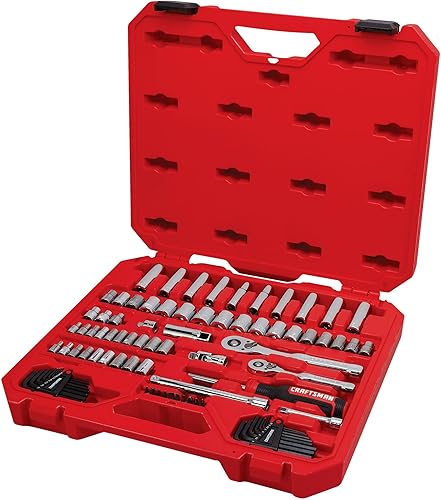 Best for cramped repair spaces
Craftsman 83-piece mechanics tool set
7.4/10 our score
See it on Amazon
- 4
 Check it
Craftsman 105-piece mechanics tool set
Best for growing home workshops - 5
 Check it
DeWalt 50-piece 3/8 inch mechanics tool set
Best for supplementing existing tools
How we chose beginner mechanic tool sets
We compared socket coverage, drive sizes, access features and storage to find useful starting points for different beginners. Each pick has a clear role, from SAE repairs to mixed equipment work or adding sockets to an existing toolbox.
The order reflects the supplied scores, but the highest-ranked set won't suit every repair. A metric job makes measurement coverage more important than rank, while a cramped fastener can make ratchet access the deciding factor.
We also separated tool count from useful coverage. A hex key, a screwdriver bit and a socket each count as a piece, even though they solve different problems.
Compare these beginner mechanics tool sets
Match the measurement system first, then compare drive range and storage. Those choices narrow the field faster than the total number of pieces.
| Product | Best for | Piece count | Drive sizes | Measurement | Our score |
|---|---|---|---|---|---|
| DeWalt 108-piece mechanics tool kit | SAE starter projects | 108 | 1/4 in and 3/8 in | SAE | 8.9 |
| Amazon Basics 201-piece mechanic's socket set | mixed repair projects | 201 | 1/4 in, 3/8 in and 1/2 in sockets | SAE and metric | 8.2 |
| Craftsman 83-piece mechanics tool set | cramped repair spaces | 83 | 1/4 in and 3/8 in | SAE and metric | 7.4 |
| Craftsman 105-piece mechanics tool set | growing home workshops | 105 | 1/4 in and 3/8 in | SAE and metric | 7.1 |
| DeWalt 50-piece 3/8 inch mechanics tool set | supplementing existing tools | 50 | 7.0 |
The table shows the broad differences, not every included socket size. Before ordering, check the exact socket sizes, socket depths and accessories against the instructions for your first few repairs.
The best beginner mechanic tool sets by use
Choose the DeWalt 108-piece kit for SAE starter work, Amazon Basics for varied projects, or Craftsman when mixed measurements and confined access matter together. The smaller DeWalt suits someone filling a gap in an existing tool collection.
DeWalt 108-piece mechanics tool kit
- 108 pieces
- 1/4 in and 3/8 in drives
- SAE sockets
- Two pear head ratchets
- Extensions and adapters
A useful starting point for SAE fastener work, with two ratchets and accessories for reaching recessed nuts and bolts. Choose it when its socket sizes match your planned repairs.
Pros
- Two ratchets and drive sizes
- Includes extensions and adapters
- DirectTorque sockets target fastener grip
Cons
- Metric coverage isn't established
- No 1/2 in drive
The DeWalt 108-piece mechanics tool kit suits beginners who know their equipment uses SAE fasteners. Its two pear head ratchets cover 1/4 in and 3/8 in drives, with extensions and adapters to expand how you reach and connect tools.
That mix helps when a nut is recessed or a nearby part blocks a direct approach. An extension moves the ratchet away from the socket, but it still needs a clear path and enough room to keep the socket square.
DeWalt says its DirectTorque socket design helps grip fasteners and prevent rounding. Correct fit remains essential, so seat the socket fully before applying force.
Buy it for a defined SAE repair plan, especially if you want a socket kit you can expand as new jobs come up. Skip it as your only starter set if your next projects require metric sockets.
Don't buy adapters as a substitute for the drive tools a demanding job needs. They connect compatible sizes, but they don't increase the strength of the smaller tool.
Our guide to what size socket set you need helps turn a repair plan into a short list of required sockets.
Amazon Basics 201-piece mechanic's socket set
- 201 pieces
- Three socket drive sizes
- SAE and metric
- Hex keys and screwdriver bits
- Storage case
The broadest socket drive-size range here suits beginners working on several kinds of equipment. Hex keys, screwdriver bits and a case help keep a mixed assortment together.
Pros
- SAE and metric coverage
- Three socket drive sizes
- Includes a storage case
Cons
- Weighs 16.5 lb
- Extra tools may be unnecessary for a narrow repair plan
The Amazon Basics 201-piece mechanic's socket set is the strongest fit here for beginners moving between different types of equipment. It combines SAE and metric coverage with 1/4 in, 3/8 in and 1/2 in sockets, plus hex keys and screwdriver bits.
That variety makes sense if your weekend work includes several fastener types rather than one repeat job. It also gives you a way to keep those tools together in the included case.
The set has a chrome-vanadium steel body and a polished-chrome finish that provides corrosion protection. Dry storage still matters, especially after a repair outdoors or around damp equipment.
At 16.5 lb, this is a kit to plan around if you carry tools up stairs or walk between a storage area and your work. Choose a storage spot close enough that putting it away won't become a chore.
Buy it for varied projects with room for a larger assortment. Skip it if you only need a narrow socket range and would rather add individual tools as your skills grow.
Use our socket set size chart to understand size order and spot gaps in the range your repairs require.
Craftsman 83-piece mechanics tool set
- 1/4 in and 3/8 in drives
- SAE and metric
- 6-point sockets
- Low-profile 72-tooth ratchets
- Full lifetime warranty
A smaller mixed-measurement assortment for beginners who value access around crowded fasteners. Its case has metal hinges, and Craftsman backs the tools with a full lifetime warranty.
Pros
- SAE and metric sockets
- Low-profile ratchets for confined spaces
- Case with metal hinges
Cons
- No 1/2 in drive
- Total includes bits and keys as well as sockets
The Craftsman 83-piece mechanics tool set suits beginners who need SAE and metric tools without choosing the largest assortment. It includes 50 sockets, 2 ratchets, 5 accessories, 10 specialty bits and 16 hex keys.
Its low-profile ratchets use a 72-tooth mechanism with a 5-degree arc swing. That small reset movement helps when nearby parts limit how far you can move the handle.
Craftsman says the heads are up to 25% thinner than CMMT81747 and CMMT81748. Head clearance and handle swing solve separate access problems, so consider both when working around a crowded engine bay.
The set includes 6-point sockets and a blow-molded case with metal hinges. Craftsman backs it with a full lifetime warranty.
Buy it for mixed fasteners and restricted access, with a manageable range to learn. Skip it if your repair instructions call for larger-drive tools or socket sizes outside its assortment.
The count includes many keys and bits, so compare socket coverage directly before deciding that a larger number means more useful sockets. Our Craftsman mechanics tool set picks offer more brand options if this range doesn't fit.
Craftsman 105-piece mechanics tool set
- 105 pieces
- 1/4 in and 3/8 in drives
- SAE and metric
- 6-point sockets
- Case fits Craftsman metal storage boxes
This larger Craftsman assortment suits a beginner building a home workshop around a cased socket set. Compare its exact contents with the smaller version before choosing the extra pieces.
Pros
- SAE and metric coverage
- Low-profile ratchets
- Craftsman full lifetime warranty
Cons
- No 1/2 in drive
- More pieces don't establish a complete socket size range
The Craftsman 105-piece mechanics tool set suits a beginner building a home workshop who wants the larger of these two Craftsman assortments. It keeps the same two-drive approach and includes SAE and metric tools.
Its low-profile ratchets share the smaller set's access design, and the assortment includes 6-point sockets and specialty bits. Choose between the two Craftsman kits by the tools you need, rather than expecting the larger one to change how the ratchets work.
The blow-molded case has metal hinges and is designed to fit Craftsman metal storage boxes. That can suit someone starting with a portable case and planning a more fixed storage area later.
Craftsman backs this set with a full lifetime warranty. Keep the model number with your tool records so you can identify the set if you need support.
Buy it when the extra pieces fill clear gaps in your repair plan. Skip the larger assortment if the smaller Craftsman already covers those jobs, or if your main need is a different drive size.
For a closer look at the brands' different approaches, read our Craftsman versus DeWalt tool set guide.
DeWalt 50-piece 3/8 inch mechanics tool set
- 50 pieces
- 3/8 in drive
- Low-profile 72-tooth ratchet
- Handle with anti-slip grooves
- Chrome vanadium steel construction
A focused socket set for beginners who already have other tools and want to build around one drive size. Confirm the socket measurements needed for your first jobs before choosing it.
Pros
- Focused single-drive assortment
- Low-profile ratchet head
- Handle includes anti-slip grooves
Cons
- Single drive size
- SAE and metric coverage needs confirmation
The DeWalt 50-piece 3/8 inch mechanics tool set suits beginners who already have basic tools and want a focused socket assortment. A single-drive kit is easier to build around when you know which jobs it needs to cover.
The ratchet has a low-profile head and a 72-tooth mechanism with a 5-degree arc swing. Its handle includes anti-slip grooves, and the set uses chrome vanadium steel construction.
The sockets feature DeWalt's DirectTorque design. As with any socket, choose a snug fit and keep it seated straight rather than relying on a grip feature to compensate for poor alignment.
This set weighs 5.2 lb, which matters if your tools move between a shelf and several work areas. Its narrower drive scope is the tradeoff for someone seeking a more focused kit.
Buy it to supplement tools you already have. Skip it as an automatic all-purpose first choice if you haven't yet worked out which measurements and drive sizes your projects require.
Confirm its socket coverage before committing to a repair. Our guide to using a socket set explains how to match the socket, ratchet and fastener before you start.
What should beginners check before buying a mechanic tool set?
Check the repair requirements before the tool count. Write down the fastener sizes, measurement system, access needs and any special tools required for 2 or 3 realistic starter jobs.
Does a beginner mechanic tool set match your fasteners?
The right beginner mechanic tool set fits the nuts, bolts and screws you actually need to turn. Equipment age, origin and previous repairs can all affect what you encounter, so don't choose from the brand name alone.
SAE sockets use inch fractions, while metric sockets use millimeters. A nearby size from the other system may slide on but leave enough play to damage a fastener under load.
If your work spans several machines, both systems are useful. For one specific project, complete coverage of the required system matters more than owning both.
Which drive sizes will you use?
A 3/8 in drive is a practical middle starting point for many routine repairs. Smaller drives can help around small fasteners, while larger drives serve larger sockets and work that calls for suitable heavier tools.
Drive size describes the square connection, not the opening that fits the nut. Two sockets with the same fastener size can use different drives, and an adapter doesn't make their load limits equal.
Our guide to 1/4 in, 3/8 in and 1/2 in drive sizes explains those tradeoffs. Use the repair procedure to decide when another drive or a different tool is needed.
Do you need shallow sockets, deep sockets or both?
Choose socket depth around the fastener's position. A protruding stud may need a deep socket, while a shallow socket can preserve clearance where another part sits close above the fastener.
Extensions add reach between the ratchet and socket, but they don't create more room inside the socket. They also won't solve every sideways obstruction.
A combination wrench can be the right answer when a socket assembly won't fit. No socket set replaces every tool needed to hold one side of a fastener while turning the other.
Are low-profile ratchets useful for new mechanics?
Low-profile heads help with overhead clearance, while a small swing arc helps when the handle has limited movement. These features matter most when nearby parts crowd the fastener.
A ratchet still needs room for the socket and a safe path for your hand. A thinner head won't solve a socket that's too tall, and more teeth don't create more leverage.
Should a beginner choose a case?
A case is useful when the kit moves or shares storage space. It keeps related pieces together and makes a missing socket easier to spot before you put everything away.
Think about where you'll open it as well as where you'll store it. A shelf that holds a closed case may not provide enough room to use the case comfortably.
How many pieces does a beginner need?
Buy enough useful tools for your planned repairs, then add tools as new jobs require them. There isn't a piece-count threshold that turns a starter kit into a complete mechanic's collection.
A larger set can reduce separate shopping when your projects vary. It can also add duplicate functions or bits you won't use, so count needed tools rather than treating every piece as equal value.
Before choosing, divide your repair checklist into three groups: tools included, tools missing and tools you already have. This makes it easier to see whether a bigger set actually avoids useful separate purchases.
Leave room in your budget for job-specific needs. A socket set doesn't establish that you also have a torque wrench, breaker bar, pliers, suitable wrenches or vehicle support equipment.
Start with work you understand and can complete with the right tools. Buying a broad kit doesn't remove the need for repair instructions or make every automotive job a suitable first project.
How should you set up a beginner mechanic tool set?
Sort and inspect the set before the first repair, while you have time to learn the layout. Doing this beside a partly dismantled machine makes it easier to overlook a missing size or grab the wrong tool.
Learn the layout before taking tools out
Find the separate SAE and metric groups, then identify the drives and accessories. Read the socket markings and arrange the work area so you can compare sizes without scattering the whole kit.
Check for visible damage, a socket that won't seat properly or a ratchet direction switch that doesn't work as expected. Resolve those problems before applying force.
Gather the full repair kit
Read the whole procedure and gather the tools it calls for before loosening anything. Include supplies such as a parts tray and task light if small parts or poor visibility could slow the job.
A ratchet turns fasteners but doesn't measure final torque. When instructions give a torque value, use an appropriate torque wrench and follow the specified units and tightening sequence.
For work under a vehicle, use rated supports and the vehicle's specified support points. Never rely on a jack alone.
Keep removed parts in order
Set aside one place for tools and another for removed fasteners. Group bolts by the part they came from, since similar-looking bolts can differ in length or thread.
Return tools to the case between stages when practical. This reduces time spent searching and helps keep loose sockets out of the equipment.
How do you avoid damaged fasteners and broken tools?
Use the correct fit and stop when resistance feels wrong. More force is rarely the best first response to a loose socket, poor alignment or a fastener that won't start straight.
Seat the socket fully
Remove loose dirt that prevents a socket from sitting squarely on the fastener. Start with hand pressure and check for excess play before turning the ratchet.
For ordinary hex fasteners, a 6-point socket is often a useful choice when a tight fit matters. Our guide to 6-point versus 12-point sockets explains when each pattern makes sense.
Don't force a ratchet into a breaker bar's job
Use a suitable breaker bar when a repair calls for loosening a stubborn fastener. Don't slide a pipe over a ratchet handle to gain leverage or strike the handle to force movement.
Keep your hand clear of sharp edges and plan where it will move if the fastener releases suddenly. Pull in a controlled direction where practical rather than pushing your knuckles toward an obstruction.
Keep hand sockets away from impact tools
Use impact-rated sockets and accessories with impact tools. Chrome finish, thick walls or a socket's ability to attach don't establish that it's suitable for repeated impact loads.
None of these sets should be assumed suitable for impact use from its name alone. Read our guide to impact sockets versus regular sockets before combining tools.
Start threads by hand
Turn a nut or bolt several turns by hand before using the ratchet. If it binds immediately, stop and check alignment rather than using leverage to force it in.
Follow repair instructions for thread condition and lubrication. Adding oil where dry threads are specified can change the relationship between tightening torque and fastener tension.
How should you care for a starter mechanics set?
Clean, dry and account for the tools after each job. Chrome finishes help resist corrosion, but damp storage and trapped grime can still damage tools over time.
Wipe away dirt and moisture before closing the case. If a repair leaves oil or cleaner in the storage recesses, clean and dry those areas too.
Inspect sockets for cracks, distorted openings and worn drive connections. Set damaged tools aside rather than returning them to a slot where you'll grab them during the next repair.
Follow the brand's care instructions for ratchet lubrication and service. Avoid soaking a ratchet in solvent, which can remove lubricant from inside the mechanism.
Replace a frequently used missing socket promptly. Keeping the range complete prevents the temptation to use a loose substitute just because the correct size has disappeared.
Which beginner mechanic tool set should you choose?
The best beginner mechanic tool set is the one that covers your first repairs without forcing size substitutions. Make the final choice from your required tools, then use convenience features to break a tie.
Choose the DeWalt 108-piece kit for a defined SAE repair plan. Choose Amazon Basics when varied equipment makes broad measurement and drive coverage useful.
Choose the Craftsman 83-piece set for mixed fasteners and cramped access. Move to the 105-piece Craftsman when its extra contents serve jobs you expect to do.
Choose the DeWalt 50-piece set when you're adding a focused socket assortment to tools already on your shelf. Don't choose it simply because a smaller kit seems easier before checking your repair requirements.
Before your first job, read how to use a socket set. Then give every piece a home with our socket set storage guide so the right tool stays easy to find.
Our top 3 picks at a glance
-
1
-
2
Best for mixed repair projects
Amazon Basics 201-piece mechanic's socket set
8.2/10 our score
See it on Amazon -
3
Best for cramped repair spaces
Craftsman 83-piece mechanics tool set
7.4/10 our score
See it on Amazon
Frequently asked questions
What should a beginner mechanic tool set include?
Start with ratchets and sockets that match your planned fasteners, plus extensions for recessed locations. Check socket sizes, measurement systems and shallow or deep coverage before counting accessories.
Add combination wrenches, a torque wrench or other tools when a repair calls for them; a mechanics set isn't a complete workshop.
Is a 200-piece mechanic tool set better for a beginner?
A 200-piece set is better only when the extra tools fill needs you can name. Bits, keys and adapters all add to the count without necessarily adding socket sizes.
For varied projects, the Amazon Basics assortment offers broader drive coverage; for one planned repair, a smaller set may cover everything required.
Should a beginner buy SAE or metric sockets?
Choose the system used by the fasteners on your equipment, and buy both if your projects require both. Don't substitute a nearby size from the other system when a socket feels loose.
Our guide to SAE and metric socket sets explains the difference and helps you choose the right coverage.
What drive size is best for beginner car repairs?
A 3/8 in drive is a useful starting point for many routine car repairs, while smaller and larger drives serve different access and load needs. The repair instructions should guide your choice.
Read our guide to socket drive sizes before assuming a larger drive or an adapter makes a tool suitable.


